Harmony on Land and Sea:
Finding Music in an Exalted Maine Landscape


Four music videos featuring solo cello music by J.S. Bach, Esa-Pekka Salonen, Per Nørgård, and Dawn Avery, paired with Maine’s most scenic vistas.

Created by Wilhelmina Smith and Joe Zizzo.


Photos by Joe Zizzo

widepoolver1+c.+Joe+Zizzo-ycArt3.jpg

We are glad to be able to offer these videos for free, with the help of the Maine Arts Commission and many generous individuals. If you are able, please consider making a donation to help us continue to be able to enrich the cultural life of Midcoast Maine with our music.

Support Us

Please join our email list in order to receive a notice as soon as new videos are posted and stay up to date with other SBC news.

Join Our Email List
ycArt-bg2-2.jpg
 

In normal times, Salt Bay Chamberfest presents internationally renowned artists in chamber music concerts at our regular venue in Damariscotta, ME. One of the special characteristics of SBC in particular is its intimacy—the connections felt among the musicians and between the musicians and audience. When we could not gather together safely in 2020, these videos were created to present a new kind of access to chamber music, with wind and birds as musical partners, and nature the stage; but with music, as always, at the heart of what we do.


Video #1
Watch Now

In Round Pond Harbor, Johann Sebastian Bach’s joyful Prelude from the Cello Suite No. 6 in D Major captures the cyclical nature of life through the energy, motion, and color of a working Maine harbor.

This video explores parallels between J.S. Bach and Round Pond Harbor in Bristol, Maine. Bach’s Prelude from the Sixth Suite for Unaccompanied Cello with its rollicking 12/8 meter, captures the energy of a working Maine harbor. Composed in the key of D Major, the movement traverses the circle of fifths (D-A-E-B-F#-C#) before returning home from its boundary-pushing harmonic adventure. This musical “circle” mirrors the naturally round harbor and as the camera orbits the cellist, becomes a metaphor for the cycle of life; of journeys to distant places and joyful returns to a home anchorage. Bariolage technique (alternating an open string with a melodic line) and repeated triplets imitate gentle harbor waves, and as the cellist sits alone on a float in the middle of the ocean, ritornello (solo versus tutti) passages conjure an image of the individual versus society. Seagulls circle above, lobster boats move about the harbor, and below the surface, crustaceans and other sea creatures are swirling, oxygenating, predating, and creating life.

—Note by Wilhelmina Smith, Artistic Director

Notes from a Maine Naturalist on Round Pond Harbor:
This semi-enclosed harbor provides calm waters within Muscungus Bay, where the Medomak River flows into the Gulf of Maine. Once the site of pogie (menhaden) processing factories, and a thriving shipbuilding industry, the Medomak River estuary is known today for its clam-producing mudflats. Soft-shelled clams are an important industry product today and they are also part of a complex intertidal mudflat habitat.

Soft-shelled clams (Mya arenaria) thrive in muddy benthic habitat where they burrow to avoid predators and desiccation. Their ecological significance stems from their vital roles in the food web, maintaining water quality, and in sediment structure management. As filter-feeders they are a primary consumer, transferring energy from tiny, floating organisms to the larger inhabitants of the ecosystem. Clams are also a primary food source for a wide array of predators at all stages of life. Larvae are consumed by fish and plankton. Juvenile clams are preyed upon by small fish, crabs, and worms. Adult clams are a critical food source for larger predators, including crabs and diving birds like common eiders. Clams pump large volumes of water to filter out phytoplankton, microscopic algae, and detritus. In doing so, they clean the water and the resulting clarity enables sunlight to penetrate the water column which promotes the growth of important seagrasses which in turn, provide habitat for American eels, horseshoe crabs, mummichogs (a small fish) and many other animals. By burrowing into the sediment, clams rework and oxygenate the mud, which affects the physical and chemical properties of the mudflat. Their shell fragments can also help buffer the sediment from increasing acidification.

—Note by Sarah Gladu, Director of Environmental Education, Coastal Rivers Conservation Trust

Video #2
Watch Now

Amid the white pines of Seal Cove Shore Preserve, Esa-Pekka Salonen’s breathe offers a balm to the many oxygen-depriving events of 2020, from COVID-19, to smoke from wildfires, to the anxiety of an unpredictable future.

This video honors all who struggled to breathe amid wildfires, a pandemic, and the social unrest of 2020.

breathe is the middle movement of a solo cello work by Esa-Pekka Salonen, knock, breathe, shine (referencing a John Donne sonnet). Marked “fluido, oscillante” and written in ¾ time, it gasps and exhales with lines unbound to its time signature, creating an improvisatory humming character. Score instructions indicate melodic lines to be played in high positions on lower strings, creating a tense and strained sound on the instrument. Breathing here is uncomfortable, desperate, and distorted.

The juxtaposition of breathe with Seal Cove Shores in Bristol, Maine—a coastal preserve with forests of pine, spruce, and an abundance of oxygen-rich plant life on its floor—provides healing through nature. Ferns blanket a marshy inlet. Coastal raptors can be heard overhead, and seals and waterfowl abound on its nearby shore. Squirrels and songbirds join in the music-making, spontaneously embellishing the music. To "inspire" or "respire" or even "expire" all derive from the Latin "spiritus" — the spirit, and the essential animating force of life. Just as the oxygen-producing plant life is dependent on the soil and the water, the video performance in turn embodies the interdependence of substance and spirit in that music is brought to life by a performer creating sound (spirit) through an instrument (substance). breathe later formed the basis for an unaccompanied children’s chorus, a setting of “Dona nobis pacem” (Grant us peace) — an excerpt from the Agnus Dei of the Latin Mass.

—Note by Wilhelmina Smith, Artistic Director

Notes from a Maine Naturalist on Seal Cove:
The bedrock of the Bristol peninsula and Seal Cove consists primarily of gneisses created during the Acadian orogeny, a dramatic mountain-building event that occurred in the Devonian period, 360–415 million years ago. During the most recent ice age, the weight of massive glacial ice depressed the land, causing the sea to flood coastal valleys after the glaciers melted some 12,000 years ago. Fine silt and clay washed out of the melting glaciers. Since then, along the shoreline, fresh and saltwater wetlands have developed over these sediments, as evident in the "primeval wetland" crossed by the trail at Seal Cove Preserve. The soils of the past define the vegetation of today. The soils are thin, having only developed since the last glaciation, giving shallowly rooted trees like spruce an advantage over some other species. Humid air from the tidally flushed estuary, and regular rains, enhances lichen growth and coastal Maine has some of the most diverse lichen communities in the world.

–Note by Sarah Gladu, Director of Education and Environmental Monitoring, Coastal Rivers Conservation Trust

Video #3
Watch Now

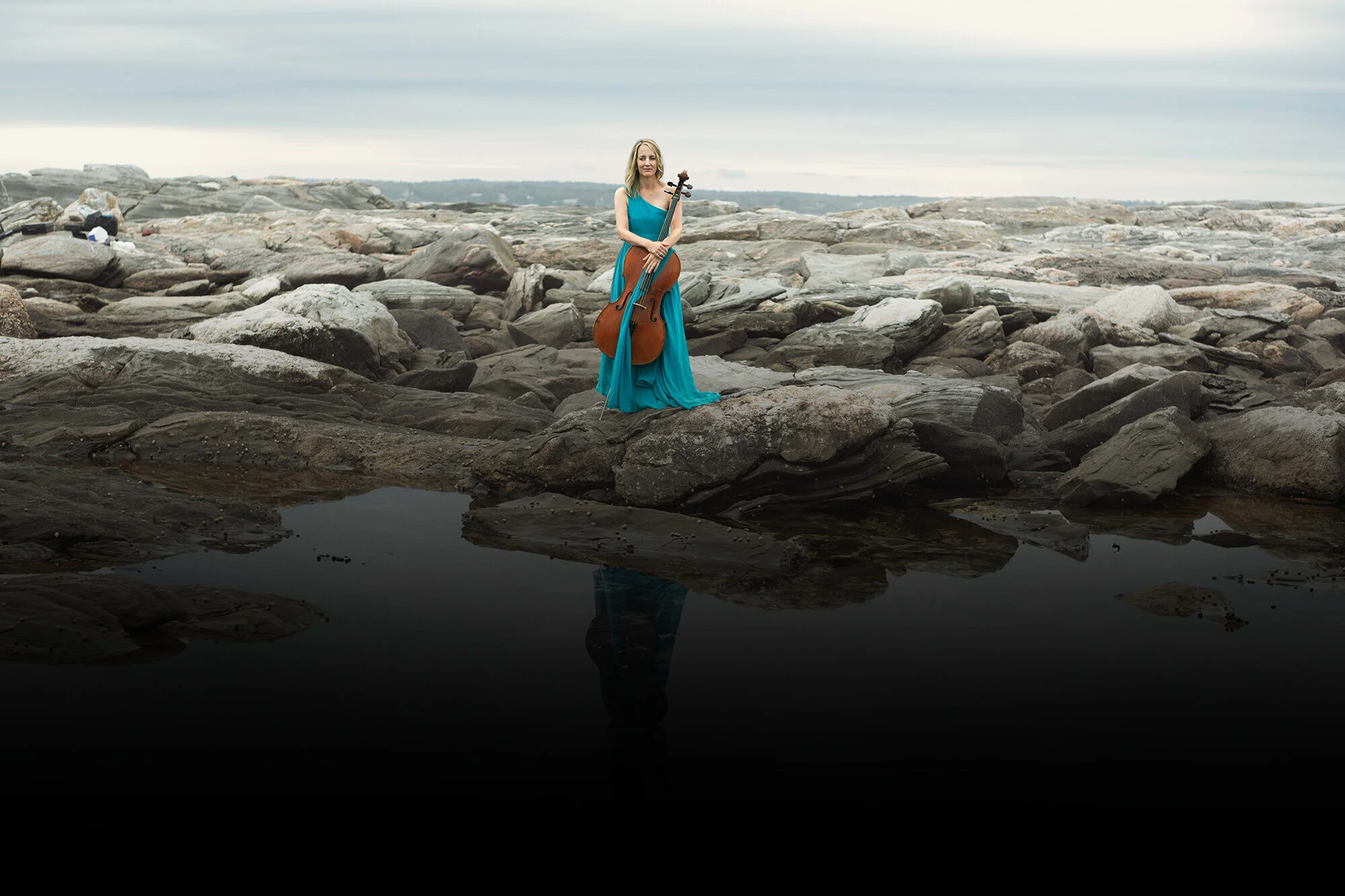
Per Nørgård’s Solo Intimo contemplates aloneness and fragility against the dramatic backdrop of crashing waves and metamorphic rock formations on Pemaquid Point.

This video contemplates the sublime in nature and the transience of life within it. Created during the pandemic, it also explores the concept of isolation.

One can imagine composer Per Nørgård writing his Solo Intimo, Sonata Quasi Una Fantasia from the vantage point of the Baltic and North seas of Denmark. Its structure is a solitary movement, beginning slowly with an adagio molto, moving through a turbulent andante development, and drawing to a muted conclusion. The camera starts from a distance, the cellist alone in a seascape amid Pemaquid’s millions-year-old metamorphic and igneous rock formations. An ascending major seventh to descending fourth “call” asks a question, and is answered by mournful, falling half-step “responses,” like the rising and ebbing of waves viewed from afar. As the camera moves closer, a passionato section of oscillating arpeggiated chords mimics turbulent flood-tide sea swells, reaching a peak in the cello’s highest soprano range. Life is abundant in tide pools below and seabirds above; with broken buoys and empty sea shells a reminder of mortality. The coda begins with a reassuring lullaby of ascending major thirds, but recedes gradually into a tidal reflection pool of harmonics, as ships sail away in the distant fog.

Karl Aage Rasmussen writes of Nørgård, “...listening to the surf from enormous waves, Nørgård suddenly became aware of a faint, extremely deep sound from the sea, unchanging by day or night. And he asked himself: Is this maybe the very fundamental tone of the ocean?”

–Note by Wilhelmina Smith, Artistic Director

Notes from a Maine Naturalist on Pemaquid Point:
Pemaquid Point juts out into the Gulf of Maine. The bare metamorphic and igneous rocks, the relentless ocean waves, and the northern climate result in a rugged, challenging habitat. However, this land-sea intersection is enriched by the nutrients from Gulf of Maine, tidal estuaries and the soils of the land itself. These nutrients, including nitrogen and phosphorus, support a vast array of plankton species, both phytoplankton and zooplankton, which form the foundation of the food web. The oxygen-rich, cold-water environment provides critical habitat for a vast array of marine and terrestrial life that is dense with planktonic food. Rockweed and bladderwrack attach to the bedrock and provide vertical structure in the intertidal habitat for periwinkles, whelks, slipper snails, barnacles, sea stars and many other animals. Migratory fish and birds benefit from the diverse life of the intertidal zone. It is not uncommon to see harbor porpoises, as well as finback and humpback whales in the area.

–Note by Sarah Gladu, Director of Education and Environmental Monitoring, Coastal Rivers Conservation Trust

Video #4
Watch Now

On the banks of the Damariscotta River, Dawn Avery’s Gratitude expresses thanks for our lives, the land, and music that fills our souls.

This video honors the beauty of coastal Maine, the ancestral lands of Maine’s Wabanaki people.

Created by Mohawk composer Dawn Avery to be played as an improvisatory piece of music of thanksgiving, Gratitude begins with a simple G major - C major pizzicato bass line, over which a melody tells a story of nature and of gratitude. The resonance of the tonic-dominant key relationship provides a sense of the familiar, of home, and like the surrounding area’s gulls and raptors, the melody soars high above before returning to a calm oasis. Arpeggiated pizzicati transform into strummed chords in the coda, affirming a sense of place. Avery writes, “The Haudenosaunee Thanksgiving Address acknowledges all helpers with layers of gratitude and blessings, beginning with Mother Earth, the people, the water, and cycling through the natural world to include the animals, insects, plants, and so on.” With views of coastal wonder, of cornfields and apple orchards, and the Damariscotta River, which was central to their existence, this film honors the Damariscotta Region and its original Wabanaki inhabitants.

–Note by Wilhelmina Smith, Artistic Director

Notes from a Maine Naturalist on the Damariscotta Region:
The Pemaquid Peninsula and the Damariscotta region are at the intersection of the southern hardwood-forests and the northern spruce-conifer forests. The region is bordered on one side by twelve miles of flowing, tidal waters of the Damariscotta estuary; and it is intersected by the Pemaquid River, as well as being dotted with fresh water bodies like Clarks Cove and Muscungus ponds. The diversity provided by habitat transition zones along the water-ways, the movement of water itself and the climate which is seasonally variable, all contribute to the nutrient cycling that supports this biological diversity and richness. Water is life and these waters are well-oxygenated and nutrient-dense.

In testament to the resources available in the region, alewives, American eels, monarch butterflies, nightjars (a bird), dozens of waterfowl, raptors, shorebird and warbler species, and green darner dragonflies migrate through this region. They depend on the wealth of resources available as they undertake perilous annual trips to nesting, spawning and feeding grounds and back again. Wabanaki people have lived here since time immemorial and the natural communities of forests, fields, estuaries and coastal areas have provided them with all they needed for thousands of years.

–Note by Sarah Gladu, Director of Education and Environmental Monitoring, Coastal Rivers Conservation Trust


To book a virtual artist talk and/or Q&A session, please contact Miriam Fogel, General Manager, at contact@saltbaychamberfest.org.

Please visit News Center Maine’s feature on this project for a behind-the-scenes look and an interview with Wilhelmina Smith.


About the Artists


Wilhelmina Smith is Founder and Artistic Director of Salt Bay Chamberfest. A graduate of the Curtis Institute of Music, she has enjoyed a wide ranging career that has included international solo appearances, being a member of several chamber music groups, performing with pop artists such as Sting and Bruce Springsteen, and playing on occasion in the cello section of the New York Philharmonic. “A consummate communicator of the new virtuosity” (The Strad), her recording of works by Finnish composers was released on the Ondine label last year to critical acclaim by BBC and Gramophone.

Joe Zizzo started his career working on such independent films as Kids and The King of New York after attending visual arts film school in New York City. Since then, he has shot music videos featuring everyone from the Beastie Boys and Aerosmith to Mary J. Blige, Common, and Missy Elliott to indie bands Muse and Pulp, as well various commercials and independent features.


CREW

Monte Zizzo is a senior at Brooklyn Technical High School in New York where he is majoring in aerospace engineering. Monte is interested in music, fashion, art, film, and skateboarding. In college he plans concentrate his studies at the intersection of business, art, and design.

Isaac Russell is a senior at Lincoln Academy in Newcastle, Maine, and plans to pursue film in college. He is interested in the medium's capability to inform and change opinion about today's issues, primarily around the environment.

Giovanna Mandarano is a sophomore at Central High School in Saint Paul, MN, plays violin in her school and community youth orchestras, and is on the CHS swim team. 


Thank You

Maine Arts Commission and the Onion Foundation
Towns of Bristol, South Bristol, and Damariscotta
Coastal Rivers Conservation Trust
Ondine Records
Robert Ball, Peter Poland, Buddy Poland, Marc & Vivian Brodsky

Funded in part by a grant from the Maine Arts Commission, an independent state agency supported by the National Endowment for the Arts.


ycArt-bg2.jpg